Estimated reading time: 10 minutes
Table of Contents
Designing a new hospital, clinic, or diagnostic center in the UAE is a complex, highly regulated process. Healthcare facility design involves ensuring that project teams must work within
DHA,
DOH, and
MOHAP requirements, account for cultural expectations in planning and operations, and make decisions that directly affect safety, dignity, and long‑term performance.
Understanding the intricacies of
healthcare facility design is crucial for creating environments that cater to patient needs. This guide walks you through the essentials in plain language, with links to the official standards so you can always verify the details for your specific project.
Who This Guide Is For
- Developers planning new healthcare facilities in the UAE
- Architects and interior designers working on hospitals, clinics, or medical centers
- Healthcare operators expanding or renovating existing spaces
- Project managers who need to align design, regulation, and approvals
1. Designing for Compliance, Culture, and Care
The
UAE healthcare market is projected to keep growing strongly to 2025 and beyond, and that growth is reflected in demand for new hospitals, specialty clinics, and diagnostic centers.
To deliver a successful facility, you need to balance three things from day one:
- Regulation: meeting DHA, DOH, MOHAP, and free‑zone requirements for safety and licensing
- Culture: respecting privacy, family roles, and religious practices in how space is arranged
- Care quality: using evidence‑based design to support infection control, wayfinding, comfort, and staff workflows
When any one of these is ignored, projects slow down, face redesigns, or underperform once they open.
2. Key Authorities and Jurisdictions
Before you get into floor plans, you need to know who regulates your facility. Different Emirates and free zones have different authorities and processes.
| Authority |
Jurisdiction |
Typical Facility Types |
Key Responsibilities |
| Dubai Health Authority (DHA) |
Dubai (mainland) |
Hospitals, clinics, labs |
Health facility licensing, design and engineering standards, infection control |
| Department of Health – Abu Dhabi (DOH) |
Abu Dhabi Emirate |
All healthcare facilities |
Licensing, standards, data reporting, alignment with international quality benchmarks |
| MOHAP |
Northern Emirates (Sharjah, Ajman, UAQ, RAK, Fujairah) |
Public and private healthcare facilities |
Federal licensing requirements and minimum standards |
| Dubai Healthcare City (DHCC) |
DHCC Free Zone |
Private healthcare providers in the free zone |
Free‑zone regulations plus international best‑practice standards |
Action step: Early in the project, confirm which authority will license your facility, then download their
latest manuals and facility guidelines rather than relying on summaries.
3. Core Design Pillars: Safety, Infection Control, and Accessibility
Each authority publishes detailed manuals and
health facility guidelines that set minimum expectations for room types, flows, safety systems, and engineering.
You will find specifics there for your project type, but three themes show up consistently: infection prevention and control, life safety and engineering, and spatial and accessibility standards.
3.1 Infection Prevention and Control (IPC)
Infection control is not just a clinical issue—it shapes:
- How you separate clean and dirty flows
- Where you locate hand‑washing and disinfection stations
- How air moves between rooms and departments
For example,
DHA’s Health Facility Guidelines and
engineering standards set expectations for ventilation strategies, pressure relationships in isolation rooms, and dirty‑to‑clean workflows in CSSD and procedure areas.
Some design responses that often appear in compliant facilities:
- Dedicated isolation rooms with negative or positive pressure, depending on use
- Clear clean and dirty separation in operating suites, endoscopy units, and sterilization areas
- Hand‑hygiene points at key decision nodes, such as patient room entrances, staff corridors, and procedure areas
The exact figures and room requirements should always be taken from the current edition of the relevant authority’s guidelines for your project type.
3.2 Life Safety and Engineering
Life safety requirements are another core pillar and typically cover topics like:
- Fire strategy: including compartmentation, fire‑rated walls and doors, escape routes, and protected lobbies
- Medical gases: including central manifolds, alarms, and emergency reserves sized for your bed numbers and acuity
- Emergency power: including backup power capacity and which areas must remain operational during an outage
- Structural and MEP resilience: including cooling capacity for high ambient temperatures and continuous 24/7 operation
DHA,
DOH, and
MOHAP often reference or align with international standards while tailoring requirements to local climate and risk profiles.
3.3 Spatial and Accessibility Standards
Spatial standards help ensure accessibility, safe movement of beds and equipment, and patient dignity.
You will see in the
room data sheets and schedules of accommodation that each authority defines minimum areas for different room types and expected clearances around beds, sanitary fixtures, and equipment.
Examples of how these standards influence design:
- Corridor widths that allow two beds plus staff to pass safely
- Door widths that accommodate stretchers and wheelchairs
- Waiting areas sized for realistic visitor numbers, not just nominal patient counts
- Accessible toilets, ramps, and lifts that meet or exceed disability access regulations
Because exact dimensions and ratios can vary by facility type and Emirate, always confirm them in the latest
standard components and room data sheets published by your authority.
4. Cultural Intelligence: Privacy, Family, and Faith
Regulations describe the minimum, but cultural expectations shape whether a facility actually works for patients and families.
In the UAE, this typically means:
- Strong expectations for privacy and modesty, especially in maternity, women’s health, and imaging
- A family‑centric model of care, where relatives are present throughout the patient journey
- Integration of faith practices, including prayer, ablution, and clear Qibla orientation
4.1 Privacy in Practice
Design strategies that respond to local expectations can include:
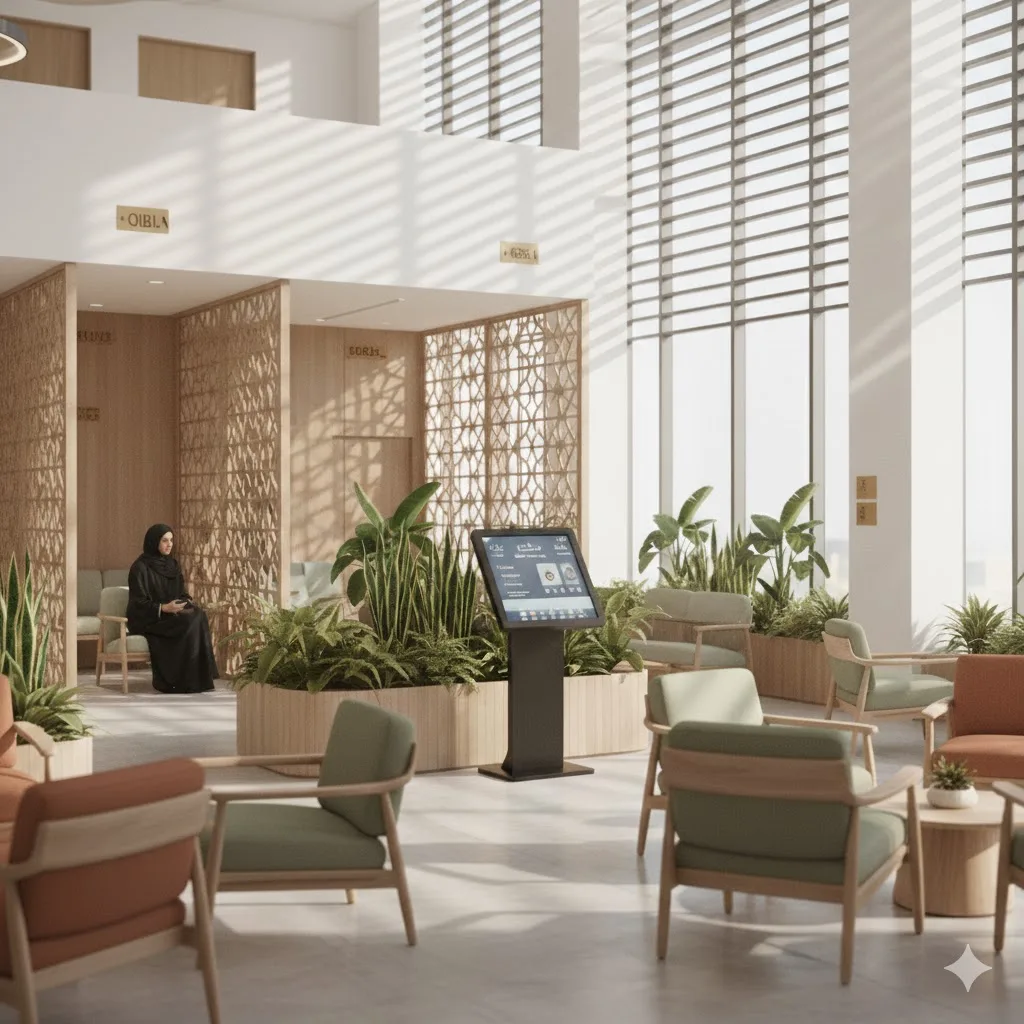
- Separate or screened waiting areas for men and women, particularly in sensitive departments
- Registration and triage desks that are angled or recessed to reduce direct views and overhearing
- Use of smart glazing or curtains at key points (for example, imaging, examination rooms, and treatment bays) to allow staff visibility while protecting dignity
4.2 Family‑Centred Spaces
Families in the UAE often accompany patients in larger groups and stay longer than in many Western contexts. Practical design responses include:
- In‑room family zones with seating, storage, and space for personal items and prayer
- Multi‑generation waiting areas that balance quiet zones for elders with play corners for children
- Counseling rooms that are sized for patient, family, and clinical team conversations without crowding
4.3 Faith‑Sensitive Design
Faith‑aligned features are now common expectations, not extras:
- Prayer rooms and wudu (ablution) areas sized for peak demand and distributed sensibly in larger facilities
- Clear Qibla indicators in inpatient rooms
- Scheduling and staff‑flow planning that respects prayer times, particularly for on‑site staff facilities
These elements are rarely the reason designs are rejected, but they strongly influence satisfaction once the facility opens.
5. Evidence‑Based Design for the UAE Climate
The UAE’s climate, light conditions, and urban patterns affect how hospitals and clinics perform day‑to‑day. Good design decisions here improve comfort, energy performance, and staff and patient experience.
5.1 Thermal and Visual Comfort
Authorities emphasize
sustainable, resilient healthcare buildings, and local green‑building frameworks such as Estidama and Al Sa’fat reinforce this direction.
Design responses often include:
- Orientation and shading that limit heat gain while preserving daylight
- Use of screens and overhangs inspired by regional precedents to control sun without creating dark interiors
- High‑performance glazing and envelopes to manage cooling loads
- Integration of landscape, courtyards, and planting to soften clinical environments and encourage movement
5.2 Biophilic and Restorative Spaces
Courtyards, green walls, and planted terraces are increasingly used in regional healthcare environments to:
- Provide visual relief and a connection to nature
- Help with wayfinding by acting as recognizable anchors
- Support staff wellbeing with accessible outdoor or semi‑outdoor break spaces
Exact acoustic and environmental performance targets will depend on the authority and project type, but the principle is clear: nature and daylight are treated as clinical assets, not just aesthetic upgrades.
6. Wayfinding for a Multicultural Population
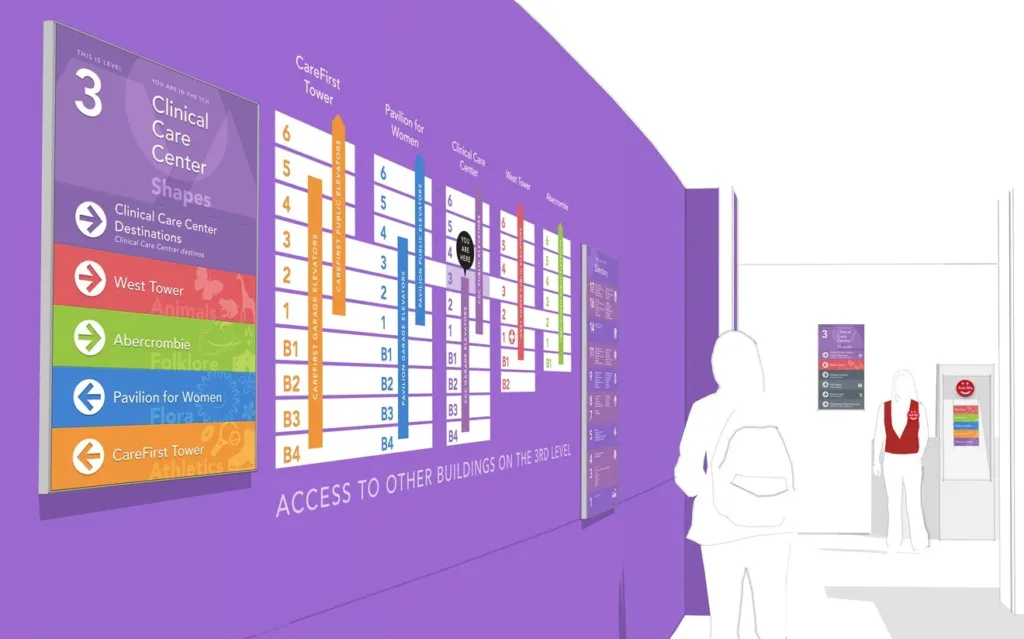
UAE healthcare facilities serve residents and visitors from a wide range of language and cultural backgrounds. When wayfinding is poor, reception desks and nurses’ stations become bottlenecks.
Effective strategies typically combine architecture, graphics, and digital tools:
- Clear zoning using colors, symbols, and simple naming for departments
- Memorable landmarks such as atria, courtyards, or artworks that visitors can easily recognize
- Consistent signage in Arabic and English, with additional languages where appropriate
- Digital layers such as QR codes, mobile maps, or kiosks that support those who prefer phone‑based navigation
These tools are not specified in detail by regulators, but they strongly influence user satisfaction scores and operational calm in lobbies, emergency departments, and lift lobbies.
7. Official Documentation and Where to Find It
Because regulations and manuals are updated periodically, always work from the latest official documents.
Here are starting points you can bookmark:
Dubai – Dubai Health Authority (DHA)
Abu Dhabi – Department of Health (DOH)
- Standards portal: central hub for current standards on infrastructure, quality, and operations
- Healthcare guidelines: clinical and service‑delivery guidelines that influence how spaces are used and organized
Northern Emirates – MOHAP
When in doubt, check the date on any PDF you download and confirm that you are using the latest version from the official website.
8. A Practical Workflow for Regulatory Compliance
To reduce redesign, many teams now treat regulation as a design input from day one rather than a box‑ticking exercise at the end.
Here is a simple, practical sequence you can adapt to your project:
8.1 Early Alignment and Briefing
- Confirm the licensing authority (DHA, DOH, MOHAP, or a free zone)
- Download the latest facility guidelines, licensing manuals, and room data sheets
- Run a multi‑disciplinary briefing workshop with clinical leaders, operations, infection control, and facilities management
- Translate key regulatory requirements into a short list of design drivers, for example isolation strategy, single‑room strategy, clean and dirty flows, and future expansion zones
8.2 Concept and Schematic Design
- Test site massing and access against ambulance, public, and service flows
- Map patient, staff, and materials journeys to identify long travel distances, cross‑flows, or crowding points
- Check early layouts against room area minimums, adjacency expectations, and clean and dirty separations from your authority’s guidelines
Many regulators encourage
early engagement and pre‑application discussions, even before formal submissions.
8.3 Design Development and Technical Coordination
- Develop detailed room layouts aligned with official Room Data Sheets and standard components
- Coordinate architecture, MEP, medical equipment, and IT at model level, often BIM‑based
- Prepare internal compliance checklists that reference specific guideline clauses
8.4 Submissions, Inspections, and Iterations
Licensing processes usually follow a cycle of:
- Initial inspection or concept review of the proposed facility
- Architectural plan review, including engineering inputs
- Final inspection of the built works before license issuance
Responding promptly and clearly to comments from reviewers keeps this cycle moving and reduces the risk of major redesign.
Future‑Proofing for 2030 Healthcare
UAE regulators are embedding
innovation, digital health, and sustainability into their standards, signaling a shift toward facilities that can adapt as care models evolve. Across projects, a few patterns repeatedly slow approvals or force redesign:
- Teams often start design before confirming jurisdiction, investing months in layouts without knowing whether DHA, DOH, MOHAP, or a free zone will license the facility
- Designers rely on memory or precedents instead of the latest manuals and room data sheets
- Underestimating family presence in waiting rooms and corridors
- Leaving infection control and clean‑dirty flows to late stages when structure and MEP are fixed
- Submitting fragmented architectural, MEP, and equipment information that triggers review delays
Building in regular internal reviews against guidelines and checklists from day one is one of the simplest and most effective ways to reduce these risks. Use this guide as a conversational starting point with your team and consultants, then anchor every decision in the current official documents for your authority of that combination of solid regulatory grounding and thoughtful, human‑centred design is what turns a compliant facility into a place people actually trust and want to use.