


Introduction
The United Arab Emirates is rapidly solidifying its position as a global hub for medical tourism, driven by strategic investments in world-class healthcare infrastructure and a national vision for smart city futures. This ambition, outlined in frameworks like “We the UAE 2031,” positions the nation at the crossroads of Europe, Africa, and Asia, ready to deliver advanced care. However, in an arid climate defined by rapid urbanization—where 87% of the UAE’s population lived in dense cities in 2021—simply building more hospitals is not a sustainable or sufficient strategy. The approach must become smarter and more holistic.
A new paradigm for creating high-performance healing environments is emerging, one that moves beyond conventional construction to integrate a deeper, more adaptive intelligence. This framework can be understood as a “Triad of Design,” a synergistic model that fuses Regulatory Precision, Cultural Intelligence, and Evidence-Based Care into a new definition of high-performance.
1. The Foundation: Regulatory Precision
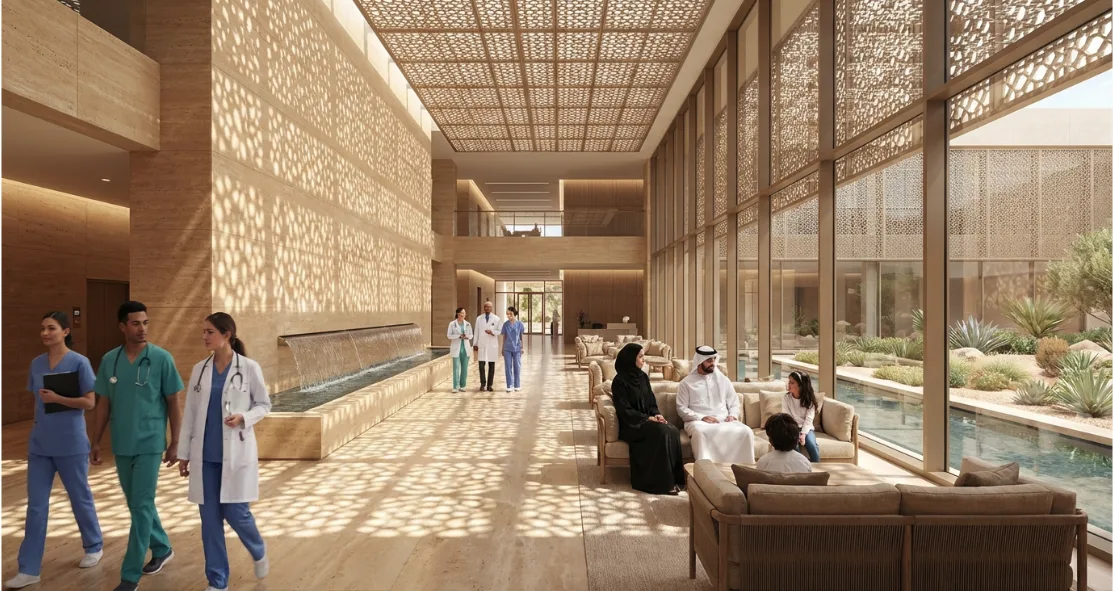
The first pillar moves beyond basic compliance to strategically master complex green building standards, creating a truly sustainable and resilient foundation. In the GCC, this means navigating the new regulatory landscape defined by local standards such as the UAE’s Al Sa’fat and Saudi Arabia’s Mostadam. These frameworks are reinforced by ambitious national strategies, including Saudi Vision 2030 and “We the UAE 2031,” which encourage sustainable practices in energy, housing, and water.
Barriers to the widespread adoption of green building ratings have included a lack of unified awareness, fragmented planning and a shortage of qualified professionals. Achieving Regulatory Precision, therefore, means investing in building this critical expertise and stakeholder alignment. It is the discipline of turning ambitious national goals for sustainability into tangible, high-performance assets that are optimized for the region’s unique environmental challenges. This commitment to professional development is not merely a compliance exercise; it is a strategic investment that underpins the region’s ambition to become a global leader in specialized, sustainable healthcare.
2. The Human Element: Cultural Intelligence
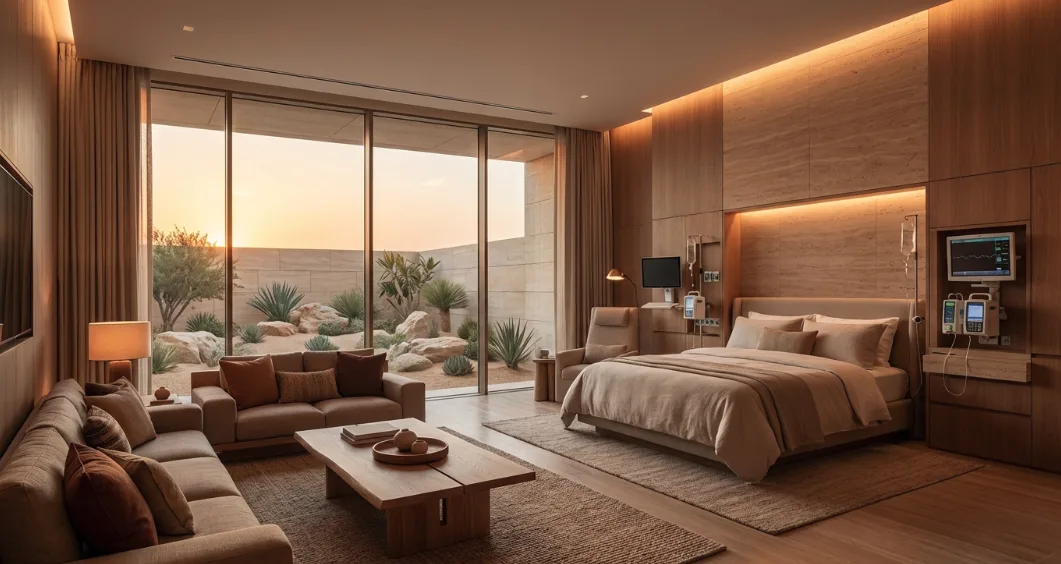
- Cultural Intelligence is the art of designing for real people—both patients and staff—who inhabit a healthcare space. It requires a deep understanding of clinical workflows, cultural sensitivities, and the psychology of a healing environment. This human-centric approach recognizes that the most advanced facility is ineffective if it fails to support those who use it.
To achieve this, design teams are increasingly including former frontline healthcare workers and operators as essential collaborators. Their clinical insights bridge the gap between architectural plans and operational reality. As one industry expert noted when discussing the role of a former clinician on a design team:
“Katherine Borge can translate operational function to the designers, who then translate it into space. That role has become a bridge in what otherwise might be a gap.”
This intelligence must also extend to patient-centric cultural needs. In a diverse region like the GCC, context is critical. For example, elderly patients with strong local dialects often “feel safe” when a healthcare professional from their own region assists them. This requires architecture that enables family presence and technology that facilitates on-demand language interpretation, ensuring the environment itself fosters trust rather than clinical detachment.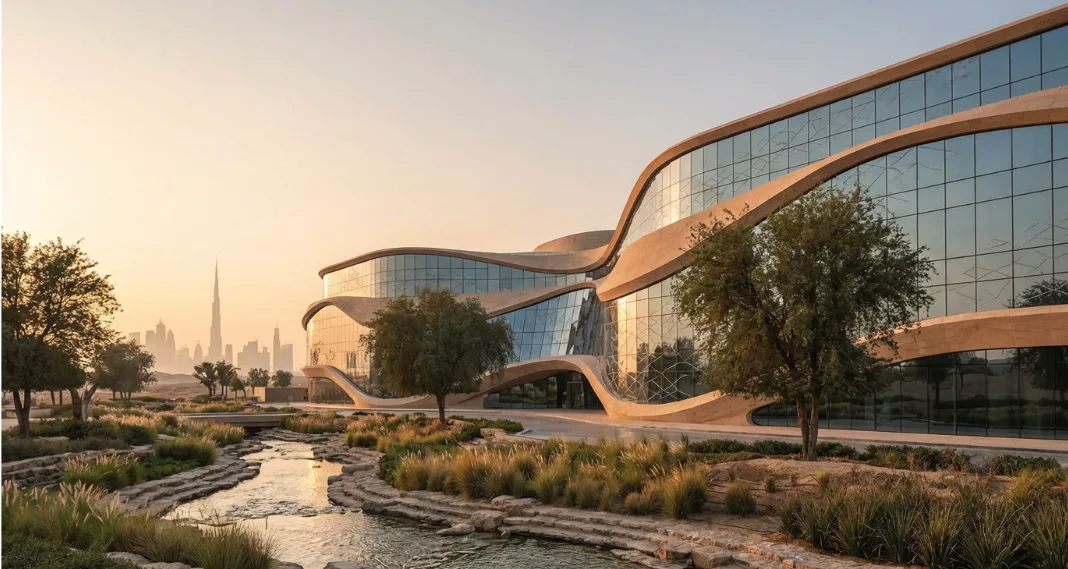
3. The Healing Catalyst: Evidence-Based Care
The final pillar leverages scientific, evidence-based principles to create spaces that actively contribute to recovery. At the forefront of this approach is biophilic design, a methodology that integrates natural elements and patterns into the built environment to “reduce stress, enhance creativity and clarity of thought, improve our well-being and expedite healing.”
Harnessing Nature’s Patterns in the Desert
In an arid climate, biophilic principles must be adapted to mitigate environmental challenges while delivering therapeutic benefits. Instead of lush greenery, “wadi-style” landscaping can be employed, using strategically designed swales for functional and interactive water management. This connects directly to the biophilic pattern Presence of Water, which is proven to reduce stress and lower heart rate.
Similarly, advanced façade systems can be designed to harness the patterns of Thermal & Airflow Variability and Dynamic & Diffuse Light. These strategies improve thermal comfort and support the body’s natural circadian rhythms. Singapore’s Khoo Teck Puat Hospital serves as a global exemplar of this principle in a tropical context, where a passive design enhances natural airflow to maintain thermal comfort for patients and staff.
The Measurable Impact
The health benefits of this approach are not just theoretical; they are measurable and well-documented. By integrating specific biophilic patterns, healthcare facilities can achieve tangible improvements in patient outcomes.
- Visual Connection with Nature: Directly linked to lowered blood pressure and heart rate.
- Non-Visual Connection with Nature: The sound of moving water or the scent of fragrant herbs can reduce systolic blood pressure and stress hormones.
- Dynamic & Diffuse Light: Variations in light intensity and color positively impact circadian system functioning, which is critical for healing.
As the UAE and its neighbors solidify their position as global leaders in healthcare, the challenge is evolving. The imperative, therefore, is no longer what we build, but how we embed a deeper intelligence that is inclusive of regulatory, cultural, and naturain to the very fabric of our healing spaces.